API design
Clear interfaces between products, applications and services with sensible responsibilities and predictable contracts.
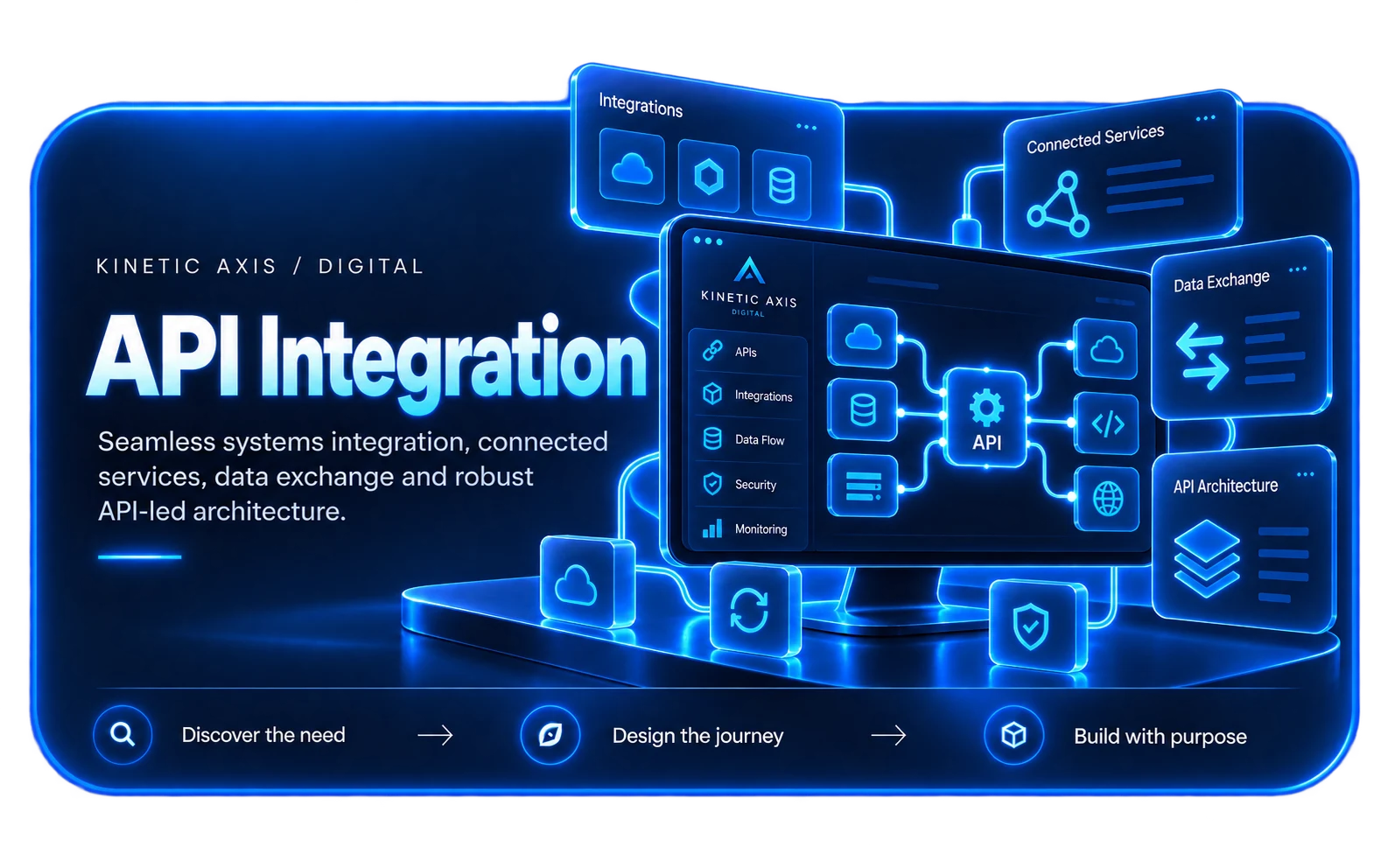
We connect products, services and data through considered APIs and integrations — reducing duplicated work and making information move where it needs to go.
We connect product thinking, interface design and engineering so the pieces work together from the outset.
Clear interfaces between products, applications and services with sensible responsibilities and predictable contracts.
Connect external platforms such as booking, payment, messaging, identity or content services where the product needs them.
Move and reconcile information between systems while considering ownership, timing and failure states.
Respond to important events and automate follow-up actions without relying on manual intervention.
Modern products rarely exist in isolation. They depend on booking platforms, payment services, identity providers, notifications, content systems or internal data. The challenge is not simply making two endpoints talk — it is deciding what should own the data, how failures are handled and what the user experiences when systems disagree.
We design integrations around reliability and understandable behaviour, with clear boundaries between your product and the external services it depends on.
See how we workWe reduce risk by understanding the workflow first, then designing and engineering the right level of solution.
Identify which system is authoritative for each important piece of information.
Define the requests, responses, events and failure handling before wiring systems together.
Implement authentication, validation, rate limits and observability around the connection.
Exercise retries, unavailable services, partial data and real operational failure modes.
Selected projects showing product design, operational tooling, reusable systems and connected experiences.
Focused solution pages for common product and operational needs connected to this service.
Use APIs and webhooks to move information through repeatable processes.
View solution EXPLOREBring data from existing systems into one clear customer experience.
View solution EXPLORECreate safer boundaries between established systems and new products.
View solutionYes, where the supplier provides appropriate access and documentation. We can design the product flow around the capabilities and constraints of that API.
That is part of the design. Good integrations consider timeouts, retries, fallback behaviour, observability and what the user should see when a dependency is temporarily unavailable.
Yes. We can design and build APIs that support web apps, mobile apps, back-office systems and future integrations from a common product foundation.
Kinetic Axis projects are senior-led. Discovery, product decisions and engineering direction stay close to the people doing the work, with direct communication throughout the project.
The post-launch model is agreed around the product. Handover, hosting responsibilities, documentation, monitoring, support and further development can be planned before release so there is a clear next step.
Good delivery is not just the build. It is making the important decisions visible, agreeing responsibilities early and keeping the product useful after launch.
Discovery, design and engineering decisions stay close to the people doing the work rather than passing through layers of account management.
We work through users, workflows, integrations and risk before turning a broad idea into a technical commitment.
Handover, hosting, support, documentation and ongoing development are discussed as part of the project rather than left until launch week.
Decisions are made with maintainability, real users and future change in mind — not just how the first release looks in a presentation.
Tell us what needs to connect, where the data lives and what the successful workflow should look like.