NODE.JS API DEVELOPMENT
APIs and backend services that hold products together.
Build Node.js backend services around clear domain rules, integrations, authentication and operational failure handling — not just a collection of endpoints.
BACKEND PRODUCT THINKING
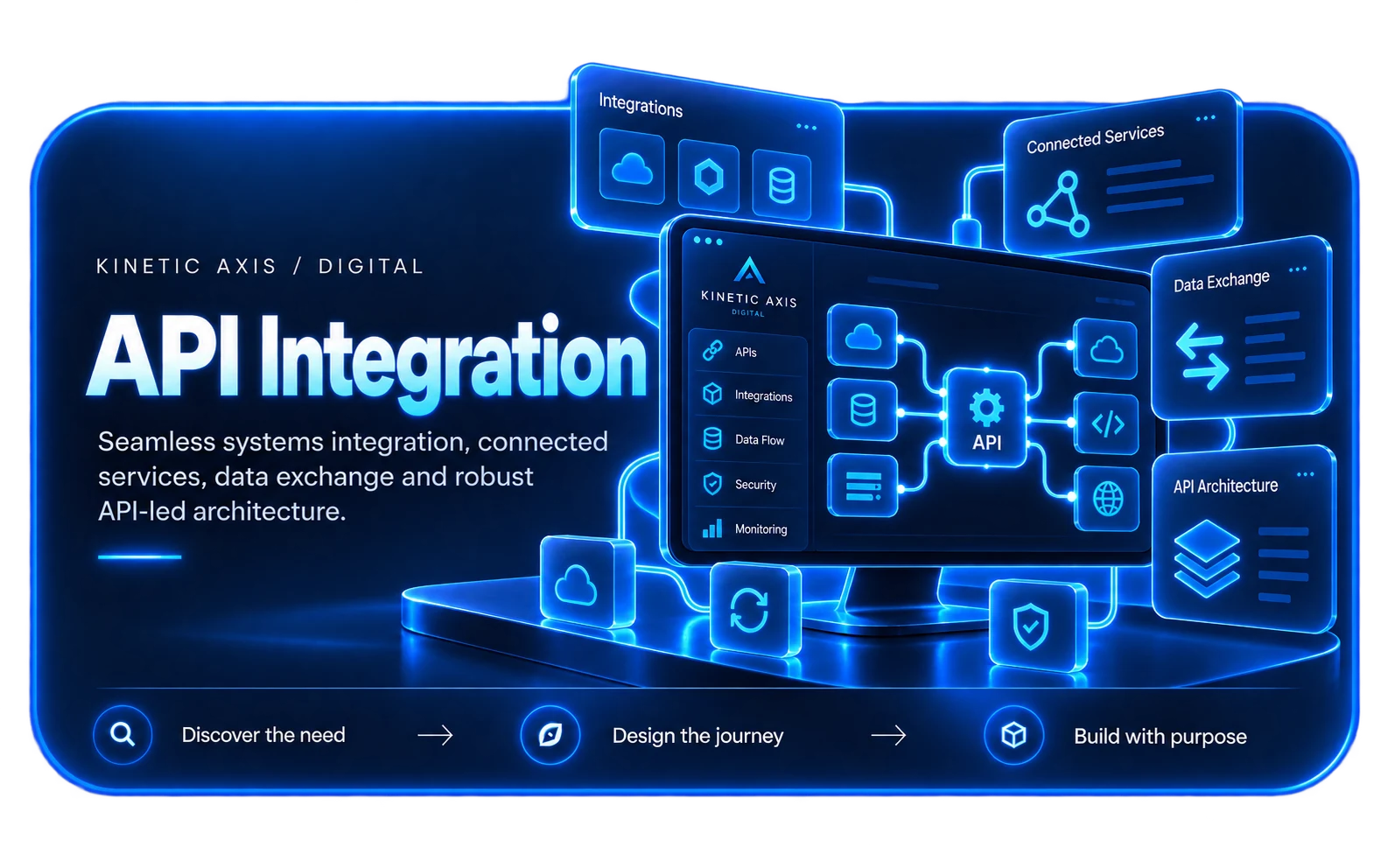
The API is where workflows, data and external systems meet.
Backend services carry the rules that interfaces depend on: permissions, validation, state changes, integrations and the recovery paths for when external systems fail.
We design the service boundary around the product domain so the API remains understandable as features, clients and integrations expand.
How we design and buildNODE.JS BACKEND CAPABILITIES
Build for behaviour, observability and change.
A useful API needs clear contracts and reliable operational behaviour, not just successful happy-path requests.
REST API design
Clear resources, validation and response behaviour shaped around real client and workflow needs.
Authentication & permissions
Session, token and role rules designed around who can do what rather than bolted on after the API grows.
Third-party integrations
Connect external services with explicit mapping, retries, idempotency and failure handling.
Background workflows
Move asynchronous work, notifications and integration tasks out of request paths where reliability requires it.
BACKEND USE CASES
One service layer can support several product surfaces.
A well-designed backend can coordinate web, mobile, admin and integration clients without duplicating business rules.
Mobile app backends
Accounts, product data, booking, rewards and notification workflows behind native or cross-platform apps.
Web application APIs
Shared backend behaviour for portals, dashboards and browser-based products.
Integration gateways
Translate data and lifecycle events between your product and external platforms.
Operational services
Centralise business rules that are currently distributed across spreadsheets, scripts or several disconnected tools.
HOW WE APPROACH IT
Make the workflow clear before the software gets complicated.
We start with users, operations and outcomes, then design the smallest coherent system that can grow with the business.
Understand the workflow
Map users, decisions, data, hand-offs and exceptions before deciding what the software should look like.
Define the product shape
Separate the core outcome from useful extras so the first release is coherent rather than over-scoped.
Design and integrate
Build the interface, data model and integrations together so the product behaves as one system.
Release and evolve
Use real operation and customer feedback to decide what should be improved, automated or expanded next.
RELEVANT WORK
Experience behind the recommendation.
Selected work showing the same kind of product, workflow or platform thinking in practice.

RELATED EXPERTISE
Connected problems usually need connected thinking.
These related capabilities often sit alongside the work on this page.
EXPLORE
API & systems integration
Connect third-party systems and data around the wider business workflow.
View capability EXPLORENext.js development
Build the web product layer that consumes modern backend services.
View capability EXPLOREPayment integration development
Handle transaction state and provider integration as part of a dependable backend workflow.
View capabilityCOMMON QUESTIONS
Useful things to know.
Can you build an API for an existing application?
Yes. We can introduce or extend a service layer around an existing product where the data and architecture allow it.
Do you work with PostgreSQL and relational data?
Yes. Relational databases are often a good fit for products with structured workflows and connected business data, though the final choice depends on the problem.
How do you handle third-party API failures?
We plan for retries, idempotency, timeouts, logging and operational recovery according to the behaviour of the external service and the importance of the workflow.
Can one API support both web and mobile apps?
Yes. Shared business rules can sit behind multiple clients while client-specific presentation remains in the web or mobile application.
Who will I work with?
Kinetic Axis projects are senior-led. Discovery, product decisions and engineering direction stay close to the people doing the work, with direct communication throughout the project.
What happens after launch?
The post-launch model is agreed around the product. Handover, hosting responsibilities, documentation, monitoring, support and further development can be planned before release so there is a clear next step.
WORKING WITH KINETIC AXIS
Senior thinking stays close to the work.
Good delivery is not just the build. It is making the important decisions visible, agreeing responsibilities early and keeping the product useful after launch.
Direct technical and product input
Discovery, design and engineering decisions stay close to the people doing the work rather than passing through layers of account management.
Clarity before commitment
We work through users, workflows, integrations and risk before turning a broad idea into a technical commitment.
Responsibilities agreed up front
Handover, hosting, support, documentation and ongoing development are discussed as part of the project rather than left until launch week.
Useful after launch day
Decisions are made with maintainability, real users and future change in mind — not just how the first release looks in a presentation.
START A CONVERSATION
Need a backend service that several parts of the product can depend on?
Tell us what needs to connect, where the data lives and what the successful workflow should look like.