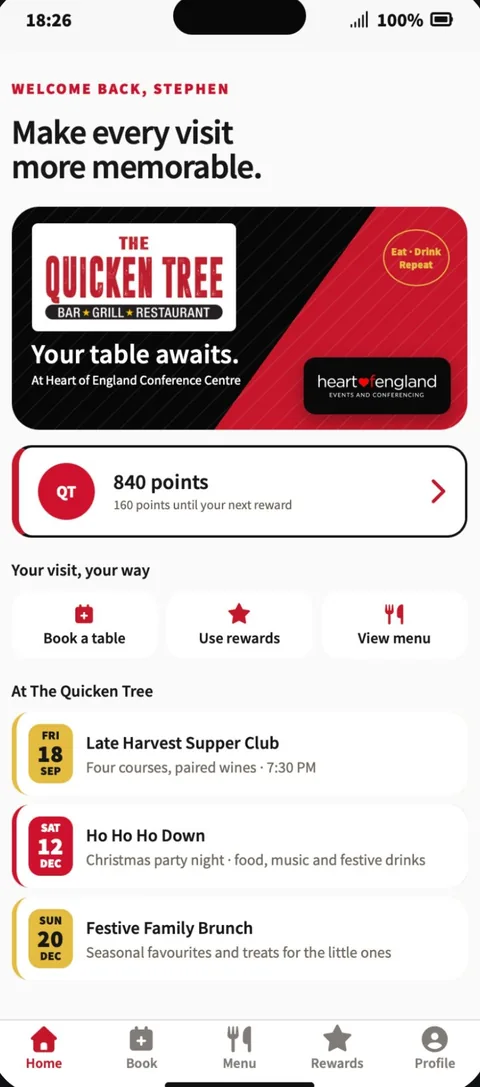

The vision.
Pace Venues was started as a hospitality technology platform, not a restaurant website: venues run on bookings, tables, menus and staff coordination, and the vision was one platform that carries all of it — for guests in the app and for operators in administration tools.
The challenge.
Hospitality platforms have two very different users: customers who want a booking experience that takes seconds, and venue teams who want a diary and table management that survives a Saturday night. Scale multiplies this — multiple venues, each with its own branding, menus and staff.
Our approach.
Development began by 19 September 2026 with restaurant-specific branding, customer-facing booking experiences and web-based venue administration, spanning iOS and Android mobile applications alongside the browser tools. The platform grew as one product with distinct journeys, not separate apps.
The engineering.
The stack: Node.js backend APIs and PostgreSQL database architecture, with a multi-tenant design that keeps venue-level data isolated. JWT-based authentication protects sessions across customer and staff surfaces. Booking diaries and table management, plus menu and dish management, give operators day-to-day control. Infrastructure work covers production hosting on Ubuntu with Nginx, SSL certificates and application monitoring, plus a push notification architecture so booking activity reaches both sides in time to matter.
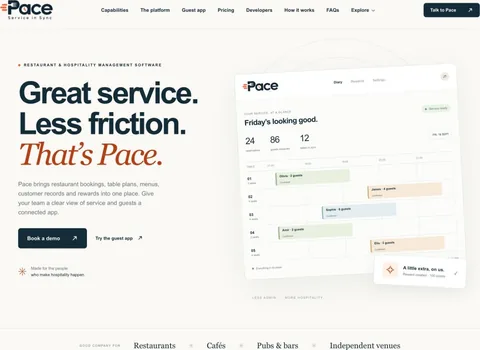
Deployment discipline.
Multi-tenant designs expose every weakness in deployment: tenant data must stay separated, sessions must be reliable, and a booking taken over the phone must be real the instant it's taken on the internet, because it will be checked by whoever seats the table. The hosting setup treats that reliability as an engineering requirement, not an operations afterthought.
The realities of a venue's day.
Hospitality software has to survive environments most digital products never meet: a phone passed between shifts, touch screens in a busy kitchen, connectivity that drops at the worst moment, and staff who need clarity at a glance mid-service. Those realities shaped the design decisions well before features did.
Big readable states, actions that forgive a slip, and flows that work one-handed while carrying something in the other hand are not accessibility afterthoughts — they are the operating requirements of the venue itself.
Where integrations earn their keep.
A hospitality platform never stands alone: payments, calendars, kitchen workflow and the roster of daily bookings it renders all live or die by how well they hand over to each other. Our thinking on every integration followed a single rule — the venue's team should never re-enter what one part of the system already knows.
That principle does the quiet work of an architecture: fewer places to make a mistake, and a team that trusts what the screen tells them because they have stopped seeing contradictions.
Booking that respects the room.
A booking diary has to model the way hospitality actually works: tables held and released, buffer windows between services, double-bookings prevented by design rather than by staff memory, and overrides that managers need occasionally and must actually be findable in the moment they are needed.
The diary design philosophy: software should spend its complexity where the operator's attention is — presenting a calm, readable picture of the day — while quietly absorbing the corner cases behind clean interactions that one glance can verify.
Mobile as the first screen.
For venue staff, the phone is the primary workstation: it moves between bars and stockrooms, it is read mid-conversation with a guest, and it is the first tool reached for when a shift breaks rhythm. The platform treats mobile as the primary surface, with the larger screens as conveniences to be enjoyed when available.
That inversion changes how everything is built: layouts drafted for one hand first, information hierarchy settled for a two-second glance, and actions whose confirmations survive being interrupted by real life.
Admin software should be boring.
The web administration follows a principle most modern software has lost: boring is a feature. That implies no clever states that trap you, no surprises in the morning, and a design that considers a failing moment carefully — a network drop mid-edit, a user returning tomorrow to an unfinished edit, a manager opening three of the same record at once.
Recoverability is designed, not hoped for: the system keeps its promises, records what happened and lets staff move on, which is how a tool earns the right to be described as dependable by people whose evenings have no slack in them.
Advice for a similar venue.
For any venue considering this route, the advice is the same advice we would give in the first meeting: start where the operational pain actually lives — usually the diary — grow the platform one process at a time, and insist that every piece of software earns adoption from the staff who will use it, day in and day out.
The technology is the easy half. The other half is process fit, change management and integration with existing 'how we already work' — and that is precisely the half where an engineering partner with hospitality awareness is worth hiring early, not after the software has been designed in the dark.
What this demonstrates.
This is substantial product engineering: mobile apps, web operations, backend APIs, database architecture and production infrastructure delivered as one platform. If your business runs on processes that off-the-shelf software handles badly — bookings, memberships, logistics — this is the standard we build to.