BOOKING SYSTEM DEVELOPMENT
Booking software designed around the real operation.
Bespoke booking systems for businesses where availability, customers, capacity, payments, notifications and staff workflows need to work together rather than live in separate tools.
MORE THAN A DATE PICKER
A booking journey is only simple when the rules behind it are understood.
Customers see a time, a date and a confirmation. Behind that interaction there may be capacity rules, venue hours, resource allocation, lead times, cancellations, staff actions, customer records and third-party systems.
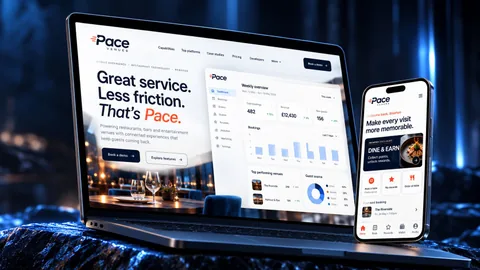
We design the public booking experience and the operational workflow together. That keeps the customer journey clear while giving the business the controls it needs to manage availability accurately.
How we design and buildBOOKING CAPABILITIES
The pieces that make a booking system dependable.
Not every project needs every capability, but the model should reflect how availability is actually created and consumed.
Availability & capacity
Model opening hours, resources, tables, appointments, lead times, buffers and other constraints around what can be booked.
Customer journeys
Create clear booking, confirmation, amendment and cancellation flows across web or mobile experiences.
Operations & admin
Give staff tools for reviewing bookings, changing availability, managing exceptions and understanding what is coming next.
Notifications & integrations
Connect confirmations, reminders, calendars, payments or third-party booking services where they add real value.
COMMON USE CASES
Where bespoke booking logic makes the difference.
A custom system becomes useful when the booking itself affects operational capacity, customer experience or several connected systems.
Hospitality
Reservations need to respect venue hours, capacity, table logic and the guest journey before and after the booking.
Appointments
Services may depend on staff, locations, duration, preparation time or resources that cannot be double-booked.
Events & experiences
Capacity, ticket types, dates, add-ons and communications need to remain consistent across the customer journey.
Multi-location operations
Each location may have its own opening times, rules and availability while the wider business needs one coherent platform.
HOW WE APPROACH IT
Make the workflow clear before the software gets complicated.
We start with users, operations and outcomes, then design the smallest coherent system that can grow with the business.
Model availability
Define what is actually being booked, the rules that constrain it and how exceptions are handled.
Design both journeys
Create the customer flow and staff workflow together so one does not create unnecessary work for the other.
Connect the ecosystem
Add payments, messaging, calendars or third-party APIs where they support the booking lifecycle.
Test edge cases
Validate amendments, cancellations, capacity conflicts, timing rules and operational exceptions before scale magnifies them.
RELEVANT WORK
Experience behind the recommendation.
Selected work showing the same kind of product, workflow or platform thinking in practice.
RELATED EXPERTISE
Connected problems usually need connected thinking.
These related capabilities often sit alongside the work on this page.
EXPLORE
Hospitality software development
Connect bookings with venue operations, menus, loyalty and guest experiences.
View capability EXPLORECustomer portal development
Give customers a secure place to manage bookings, details and account activity.
View capability EXPLOREAPI & systems integration
Connect booking workflows with payments, messaging and established third-party platforms.
View capabilityCOMMON QUESTIONS
Useful things to know.
Can you build a booking system around our existing rules?
Yes. We start by modelling the rules you already use — including capacity, lead times, opening hours and exceptions — then design the software around them.
Can a new booking flow integrate with an existing provider?
Potentially, yes. If the provider exposes a suitable API we can design a bespoke customer experience while keeping the established booking platform as part of the underlying workflow.
Can customers change or cancel bookings themselves?
Yes. Self-service amendment and cancellation flows can be included where the business rules allow them, with appropriate validation and notifications.
Can one system support multiple venues or locations?
Yes. Multi-location models can keep location-specific hours, availability and configuration separate while giving the organisation a consistent platform and reporting layer.
Who will I work with?
Kinetic Axis projects are senior-led. Discovery, product decisions and engineering direction stay close to the people doing the work, with direct communication throughout the project.
What happens after launch?
The post-launch model is agreed around the product. Handover, hosting responsibilities, documentation, monitoring, support and further development can be planned before release so there is a clear next step.
WORKING WITH KINETIC AXIS
Senior thinking stays close to the work.
Good delivery is not just the build. It is making the important decisions visible, agreeing responsibilities early and keeping the product useful after launch.
Direct technical and product input
Discovery, design and engineering decisions stay close to the people doing the work rather than passing through layers of account management.
Clarity before commitment
We work through users, workflows, integrations and risk before turning a broad idea into a technical commitment.
Responsibilities agreed up front
Handover, hosting, support, documentation and ongoing development are discussed as part of the project rather than left until launch week.
Useful after launch day
Decisions are made with maintainability, real users and future change in mind — not just how the first release looks in a presentation.
START A CONVERSATION
Need a booking flow that fits the way capacity really works?
Tell us what customers need to book, what staff need to control and where availability comes from.