HOSPITALITY SOFTWARE DEVELOPMENT
Hospitality technology built around guests and operations.
Digital products for restaurants, bars, venues and hospitality groups — connecting guest journeys such as bookings and loyalty with the operational tools teams use behind the scenes.
TWO SIDES OF THE SAME SERVICE
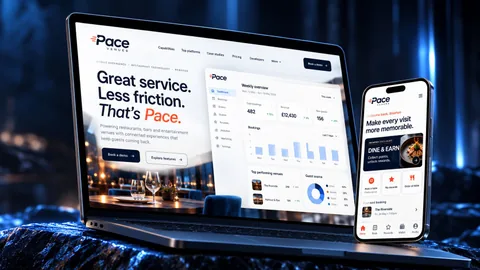
Guest-facing technology works best when the operational workflow has been designed with it.
A smooth hospitality experience can involve bookings, venue information, menus, rewards, notifications and staff actions before the guest ever arrives. If those pieces are designed separately, the customer interface can create more work behind the scenes.
We approach hospitality products as connected systems. The guest journey stays simple, while venue teams get the controls, data and configuration needed to keep the experience accurate.
How we design and buildHOSPITALITY CAPABILITIES
Digital journeys across the guest relationship.
The platform can focus on one high-value journey or connect several parts of the venue experience over time.
Bookings & availability
Customer reservation flows connected to venue hours, capacity and the operational booking model.
Menus & venue content
Digital menu, availability, venue information and event content managed from practical staff-facing tools.
Rewards & loyalty
Customer reward journeys, QR interactions and account experiences that support repeat engagement.
Venue operations
Back-office tools for managing bookings, configuration, content and the day-to-day information behind the guest experience.
WHERE WE CAN HELP
From one venue workflow to a wider hospitality platform.
Hospitality products often begin with one customer pain point and expand as the value of connected guest data and operations becomes clearer.
Restaurant groups
Shared product foundations with location-specific menus, availability, content and guest experiences.
Independent venues
Focused digital products that remove operational friction without forcing the venue into a huge generic platform.
White-label hospitality products
A common application offered under individual venue or brand identities with controlled configuration.
Connected guest services
Bookings, loyalty, notifications and venue information working as parts of one recognisable customer relationship.
HOW WE APPROACH IT
Make the workflow clear before the software gets complicated.
We start with users, operations and outcomes, then design the smallest coherent system that can grow with the business.
Map the guest journey
Understand what the customer is trying to do before, during and after a visit, and where digital support genuinely helps.
Map venue operations
Identify who maintains availability, content, bookings and customer information, including real-world exceptions.
Connect the two sides
Design APIs, back-office tools and customer interfaces as one service rather than independent projects.
Design for multiple venues
Where relevant, establish tenancy and configuration rules so additional locations do not require separate products.
RELEVANT WORK
Experience behind the recommendation.
Selected work showing the same kind of product, workflow or platform thinking in practice.
RELATED EXPERTISE
Connected problems usually need connected thinking.
These related capabilities often sit alongside the work on this page.
EXPLORE
Restaurant app development
Create a branded mobile experience for bookings, menus, rewards and venue information.
View capability EXPLOREBooking system development
Design reservation journeys around the venue's real capacity and operating rules.
View capability EXPLOREWhite-label app development
Support multiple venues or brands from a shared product foundation.
View capabilityCOMMON QUESTIONS
Useful things to know.
What kinds of hospitality software do you build?
Examples include booking journeys, guest mobile apps, loyalty experiences, digital menus, venue content tools and the back-office systems needed to manage them.
Can the platform support multiple venues?
Yes. A multi-tenant approach can keep venue data and configuration separate while sharing the core product and operational model.
Can you integrate with an existing booking or hospitality system?
Where a suitable API is available, yes. We can design a new digital experience around established systems rather than automatically replacing them.
Can you build both the guest app and the staff back office?
Yes. Designing both sides together is often valuable because operational controls determine whether the guest-facing information remains accurate.
Who will I work with?
Kinetic Axis projects are senior-led. Discovery, product decisions and engineering direction stay close to the people doing the work, with direct communication throughout the project.
What happens after launch?
The post-launch model is agreed around the product. Handover, hosting responsibilities, documentation, monitoring, support and further development can be planned before release so there is a clear next step.
WORKING WITH KINETIC AXIS
Senior thinking stays close to the work.
Good delivery is not just the build. It is making the important decisions visible, agreeing responsibilities early and keeping the product useful after launch.
Direct technical and product input
Discovery, design and engineering decisions stay close to the people doing the work rather than passing through layers of account management.
Clarity before commitment
We work through users, workflows, integrations and risk before turning a broad idea into a technical commitment.
Responsibilities agreed up front
Handover, hosting, support, documentation and ongoing development are discussed as part of the project rather than left until launch week.
Useful after launch day
Decisions are made with maintainability, real users and future change in mind — not just how the first release looks in a presentation.
START A CONVERSATION
Planning a better digital experience for guests and venue teams?
Share the guest journey, venue workflow and systems involved. We can help connect the customer and operational sides.