
Continuity as a service.
Kinetic Axis has agreed an ongoing maintenance partnership with CEMEX UK, supporting the day-to-day health of the company's web presence: updates, performance and continuity work that rarely makes headlines but keeps a national brand dependable online.
The same care at any scale.
It's the same kind of ongoing care the studio gives smaller clients, extended to an organisation where uptime isn't optional. Standing alongside an existing client list that already includes Virgin Media, O2, TCS and the Open University, the arrangement shows that the studio's approach holds up at any scale — and it's now a standing offer to businesses that need their sites looked after, not just built.
What a maintenance partnership actually covers.
The shape of this kind of partnership is deliberately unspectacular: keep the estate current, keep it safe and keep it fast. Security patching on a sensible cadence, dependency updates that are tested rather than hoped for, monitoring that notices problems before visitors do, and a steady flow of small changes — copy, imagery, seasonal content — handled without a project kickoff for each one.
What organisations get in return is continuity. The people maintaining the site know its history, its shortcuts and its quirks, so changes stay consistent with what is already there instead of quietly papering over it.
Why the big ones still need it.
There is a fair question in why a national business needs outside help for its own website, and the answer is focus. An internal team has its real job to do; the website is one of many systems it keeps alive. Web work of this kind is a discipline of small, constant decisions — and it deserves owners who make those decisions every day rather than between other priorities.
That is the logic of the arrangement: we hold the fort on the website while their teams hold their own. The site gets daily-grade attention; the client gets a partner who treats upkeep as the product rather than the interruption.
Why continuity beats a rebuild.
A recurring temptation with an ageing site is to start over. The maintenance view argues the opposite: every year of accumulated knowledge about the site — which template carries what weight, why a module behaves the way it does, which historical decisions are load-bearing — is exactly what a rebuild throws away. Continuity compounds; starting over resets everything to zero.
So the preference, whenever the foundations allow it, is steady improvement on firm ground over periodic revolution. Changes arrive reviewed, reversible and documented, which keeps the estate increasingly predictable rather than increasingly alien to the team that will maintain it next.
The rhythm, in practice.
A maintenance cadence has a satisfying shape when it beds in: content changes flowing through without ceremony, patching on a predictable window rather than a reactive panic, and a periodic review that steps back from the daily churn to ask whether the site is still pulling its weight in search and speed.
The quiet advantage of rhythm is momentum. Small improvements scheduled regularly accumulate into something a single grand redesign rarely matches, because every change lands on a site somebody has just been looking after.
How we do the same work elsewhere.
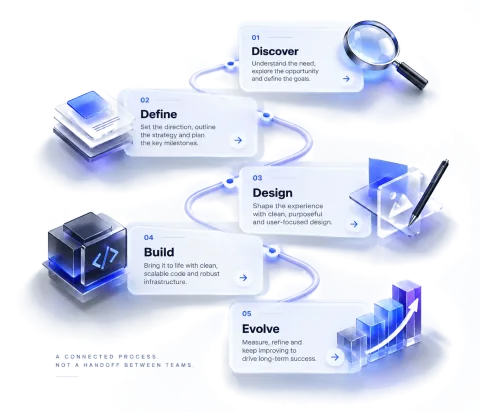
This partnership is the enterprise expression of how we already treat every project: the same senior team that builds a product stays responsible for it in production. There is no handover to a different team with less context, because context is the most valuable asset in maintenance work.
If your organisation has a website that has drifted into nobody's-job territory, that drift is the real cost — not the subscription, not the redesign quote. A conversation about a maintenance arrangement is a conversation about ending it.
Care at the moment it matters.
Maintenance earns its renaming at the moment something breaks. A partner who already knows the site answers with a fix and an explanation; a team who has never looked at it answers with a discovery period. Platform support queues and vendor tickets are not substitutes for somebody who already has the map.
That is the value in one sentence: when the site is under pressure — a traffic spike, a platform update, a security release — the team on call no longer needs a briefing, because it was briefing itself all along.