SAAS PRODUCT DEVELOPMENT
Turn a service idea into a product people can rely on.
SaaS product design and development for teams building subscription software, multi-tenant platforms or digital services that need a clear path from first release to ongoing product evolution.
PRODUCT, NOT JUST FEATURES
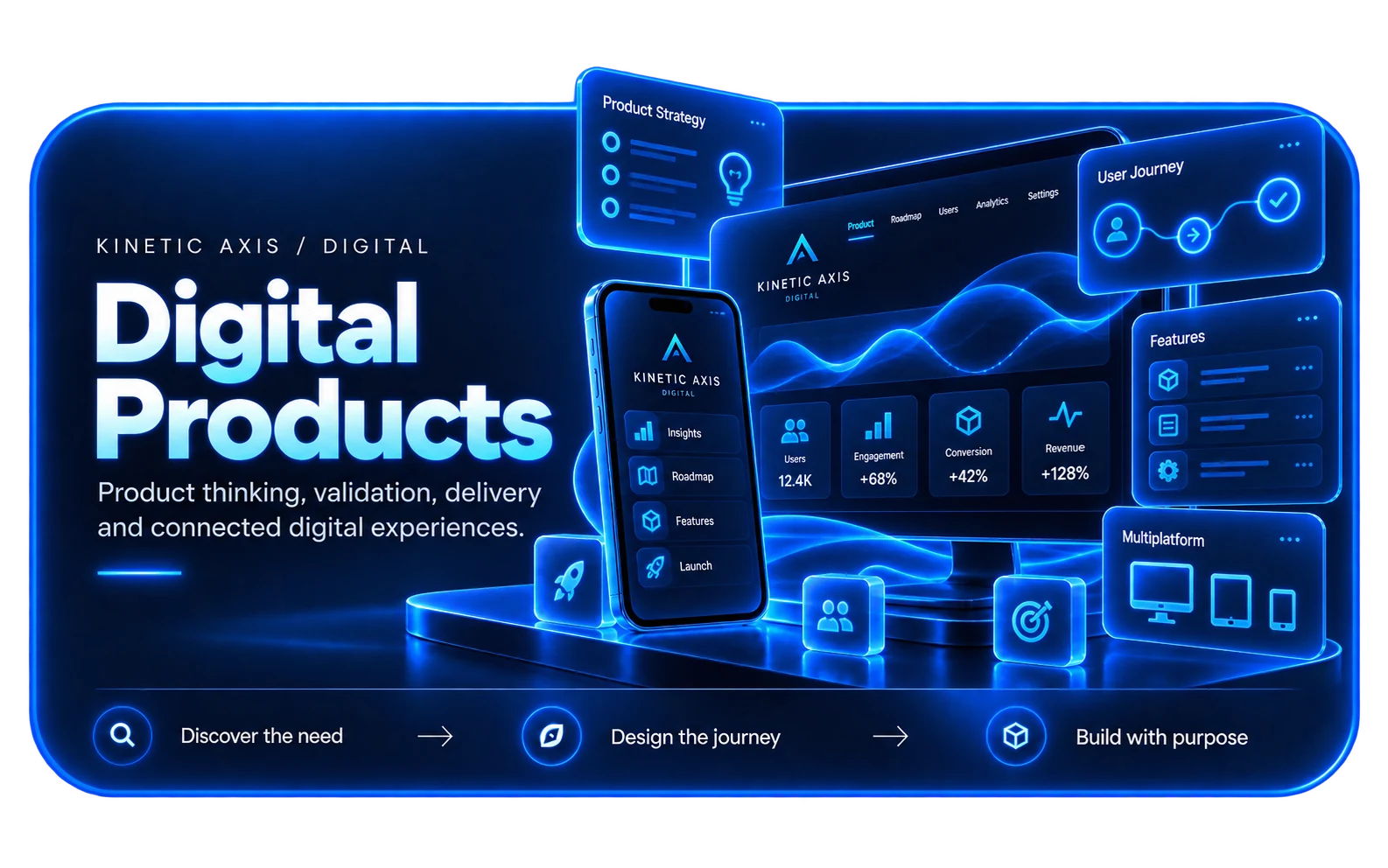
A SaaS platform has two products to design: the customer experience and the operation behind it.
The visible application is only part of a software-as-a-service product. Accounts, permissions, tenancy, onboarding, support, administration, integrations and product operations all shape whether the service is practical to run.
We help define the first useful release, design the user experience and engineer the foundations behind it. The aim is to avoid overbuilding too early while making sensible decisions about the things that become expensive to change later.
How we design and buildSAAS FOUNDATIONS
A product that can be used, operated and evolved.
Early architecture should support the business model without pretending the first release already needs enterprise scale.
MVP definition
Prioritise the smallest coherent product that proves customer value rather than shipping a disconnected list of features.
Accounts & tenancy
Design identity, organisations, permissions and data boundaries that match how customers will actually use the service.
Product operations
Create the admin, support and configuration tools needed to run the product after launch.
Integrations & evolution
Build clear interfaces around external services and create a codebase that can continue changing as the product learns.
PRODUCT STAGES
Different SaaS stages need different engineering decisions.
The right level of architecture depends on what the product has already proved and what the next commercial milestone requires.
New SaaS MVP
A team needs to move from concept or prototype to a product real customers can use and provide evidence about.
Internal tool becoming a product
Software built for one organisation has value for others and needs tenancy, onboarding and stronger product boundaries.
Existing SaaS needs modernising
The product works commercially but UX, architecture or operational tooling is slowing down the roadmap.
White-label platform
A shared SaaS core needs to serve multiple brands or organisations with controlled configuration and data separation.
HOW WE APPROACH IT
Make the workflow clear before the software gets complicated.
We start with users, operations and outcomes, then design the smallest coherent system that can grow with the business.
Define the product bet
Clarify audience, problem, commercial model and the behaviour the first release needs to prove.
Design the service model
Shape accounts, roles, tenancy, core data and operational tooling alongside the customer journeys.
Build the useful core
Prioritise complete end-to-end workflows over a large number of partially finished features.
Learn and extend
Use real product usage and customer feedback to guide what earns complexity in later releases.
RELEVANT WORK
Experience behind the recommendation.
Selected work showing the same kind of product, workflow or platform thinking in practice.

RELATED EXPERTISE
Connected problems usually need connected thinking.
These related capabilities often sit alongside the work on this page.
EXPLORE
Digital product development
Take a new digital service from product definition through design and engineering.
View capability EXPLOREWhite-label app development
Extend a shared product foundation into distinct branded experiences.
View capability EXPLORECustomer portal development
Build secure account and self-service experiences around the SaaS product.
View capabilityCOMMON QUESTIONS
Useful things to know.
Can you help define an MVP as well as build it?
Yes. We can work from an early concept, help prioritise the first coherent customer journey and identify which technical foundations are genuinely needed for that release.
Do you build multi-tenant SaaS platforms?
Yes. Tenant data boundaries, organisation accounts, permissions and configuration can be designed into the platform when the product model requires them.
Can you work on an existing SaaS product?
Yes. We can improve product UX, add operational tooling, modernise parts of the architecture or help restructure areas that are slowing the roadmap.
Do we need billing in the first release?
Not always. Billing should be introduced when it supports the commercial validation you need. Some MVPs can validate value with a simpler commercial process before subscription automation becomes necessary.
Who will I work with?
Kinetic Axis projects are senior-led. Discovery, product decisions and engineering direction stay close to the people doing the work, with direct communication throughout the project.
What happens after launch?
The post-launch model is agreed around the product. Handover, hosting responsibilities, documentation, monitoring, support and further development can be planned before release so there is a clear next step.
WORKING WITH KINETIC AXIS
Senior thinking stays close to the work.
Good delivery is not just the build. It is making the important decisions visible, agreeing responsibilities early and keeping the product useful after launch.
Direct technical and product input
Discovery, design and engineering decisions stay close to the people doing the work rather than passing through layers of account management.
Clarity before commitment
We work through users, workflows, integrations and risk before turning a broad idea into a technical commitment.
Responsibilities agreed up front
Handover, hosting, support, documentation and ongoing development are discussed as part of the project rather than left until launch week.
Useful after launch day
Decisions are made with maintainability, real users and future change in mind — not just how the first release looks in a presentation.
START A CONVERSATION
Building a SaaS product and need a coherent first release?
Tell us what people need to do, where the friction is today and what a better result would look like.