
The browser as a game engine.
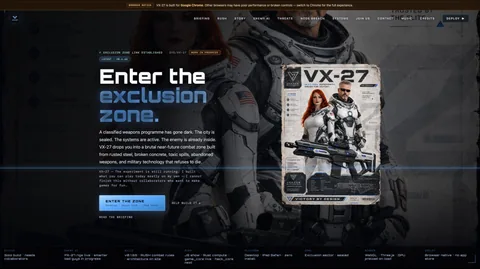
VX-27 started on 26 May 2026 as an early game concept and visual identity: a first-person experience that would live entirely in the browser. No installs, no launcher — an ambitious interactive world delivered to a URL.
Building the environment.
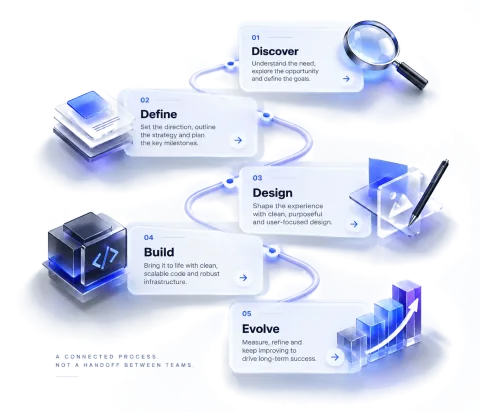
From 29 May to 1 June, development concentrated on environmental visuals and the promotional experience around them. Lighting, materials and atmosphere carried most of the identity, so the first engineering goal was a scene that looked confident on entry-level hardware.
Making it playable.
Between 4 and 7 June the work moved from looking at the world to interacting with it: interactive equipment, interface systems and game mechanics. HUD elements and controls had to feel instant, which makes performance a design decision rather than a late optimisation pass.
The technical spine.
Under the concept sits ordinary web engineering, applied hard: a WebGL renderer fed by a hand-tuned asset pipeline, pointer-lock input with sensible fallbacks, and a frame budget that treats every millisecond as headroom to defend. The environment is authored, optimised and then optimised again — delivery size matters as much as draw calls when the goal is instant-in-browser.
Progressive loading keeps first contact fast: the space is explorable long before the heaviest assets finish, and polish continues arriving in the background without breaking immersion.
Testing an experience like a product.
An interactive experience has more ways to fail than a page, so it earned a product-grade test loop: hardware coverage across laptop and desktop tiers, input devices beyond the obvious mouse, and attention to the small stuff — resizing, tab-switching, coming back after sleep — that separates a demo from something deployable.
The outcome is a reproducible experience rather than a lucky build: open the URL and it works, the same way, every time.
Where the browser beats a native build.
A first-person experience in the browser is not a compromise against a native game engine — it is a different distribution model. No install, no store page, no gatekeeping: a link that is a playable world for anyone who clicks it. For brands, that difference is the point; reach beats fidelity at every stage of the funnel.
The craft lies in spending frame budget where players feel it — motion, input response, the sense of place — and being ruthless everywhere else. What is traded away in visual extravagance comes back as the ability to say: it is running right now, on your machine, in a tab.
The craft of a believable space.
Believability in a 3D environment is mostly restraint. Fewer, better-considered structures read faster than dense clutter; consistent lighting direction does more for orientation than any amount of texture; and the spaces between objects — sight lines, thresholds, cover — are where a first-person experience feels authored rather than assembled.
That environment art was built to be readable at pace. A player moving quickly through the world should still be able to read where they are, which direction they are facing and what is about to matter — an interface problem disguised as an art problem, and solved as such.
Input and responsiveness under pressure.
First-person input is unforgiving. The moment between thinking about turning and the world turning is the entire product, so input latency sits at the top of the engineering stack rather than at the bottom: pointer lock for precision, direct event handling rather than framework machinery, and frame pacing treated as a feature with an owner.
When a browser or device cannot hold the target, the experience is expected to admit it gracefully — lowering internal complexity rather than stuttering — because a slightly simpler world that never stutters beats a lavish one that does.
What VX-27 changed for client work.
Experiments like this reshape the advice we can give clients, because the page “is 3D in the browser practical?” now has a first-hand answer with receipts. Frame budgets, asset weight, device coverage and the honest limits of pointer-driven interaction are no longer spreadsheet estimates — they are lived numbers from a shipped build.
That is the whole logic behind the studio's Labs work: the next time a brand asks for an interactive experience that leaves competitors' sites behind, we are not promising from theory. We have already paid the tuition.
What this demonstrates.
The same techniques behind an in-browser FPS — real-time 3D, procedural objects, HUD systems, careful rendering budgets — translate directly into product configurators, virtual showrooms, training tools and data visualisation. If your product needs to feel like an experience rather than a page, this is the engineering behind it.