Why this studio exists.
Kinetic Axis was established in 2026 for one reason: too much digital work is delivered by fitting a template to a business and calling it bespoke. This studio is engineering-led, which means the solution follows the problem — websites, web applications, mobile applications, digital products and SaaS platforms, AI-assisted software development, and the modernisation of legacy applications.
What we build.
Original solutions are designed and built around the client: performance, accessibility and technical SEO treated as engineering fundamentals rather than finishing touches, with digital strategy and engineering consultancy sitting alongside delivery so decisions stay connected to commercial outcomes.
A clear position on existing platforms.
That doesn't make off-the-shelf the enemy. We support, maintain, improve and modernise existing platforms — including WordPress and enterprise content-management systems — and we will say so when an established tool is the right commercial choice. Where a restrictive system is genuinely holding a business back, we help organisations transition from off-the-shelf constraints to bespoke applications when there's a real technical and commercial benefit, not just a preference for shiny.
Why work with us.
The projects behind this site — a browser-based 3D experience, a React component library, a hospitality platform, marketplace design — exist because thinking in solutions is how the studio works. If a project deserves engineering rather than assembly, that's the conversation to have.
How the studio works.
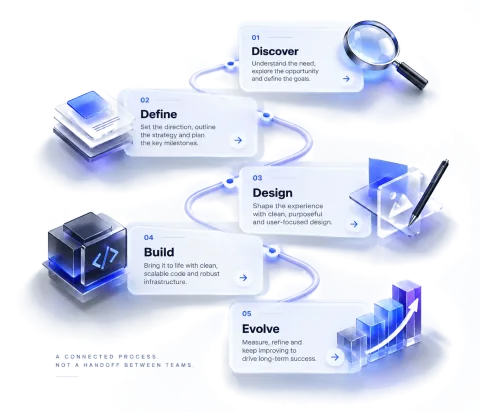
The method is deliberately old-fashioned in intent: understand the business first, shape the product second, engineer it properly third, and stay through launch and beyond. What is modern is the toolkit — a disciplined, AI-accelerated build process under review gates that keep quality owned by people, not delegated to probability.
One senior maker per project is the working model, with the whole studio's thirty-plus years of web experience behind it. Clients talk to the person doing the work — which in practice is the single biggest quality lever available.
Who this is for.
Kinetic Axis suits businesses at decision points: a founder with an idea that has outgrown a template, an operations lead whose team runs on spreadsheets that are one hire away from breaking, an established business whose website quietly costs more than it earns.
If you need a one-page site this week from a page builder, plenty of routes will already serve you well — and being able to say so honestly is part of the position. If you need a digital product built to survive your business growing into it, that is the work this studio was set up to do.
One studio, one thread.
Most projects fail quietly at the seams: the design agency hands files to a developer, who hands the build to specialists, who hand the lot to a marketing partner, each seam costing intent. Kinetic Axis exists, in part, to remove those seams — design, development, product thinking and the growth work afterwards all under one roof and one accountable team.
That connected approach is not a packaging convenience. Decisions made in week one — how the content is structured, what the interface optimises for, how the software should behave at scale — are easier to keep coherent when nobody has to be briefed on yesterday's decisions over email.
The technology stance.
The studio builds web-first and framework-flexible: TypeScript across Angular, React and Next.js on a Node.js foundation, with architecture chosen to serve the product rather than the CV. Static-first where the brief allows it, because speed, search visibility and resilience come from design rather than decoration.
Build discipline is treated as a quality gate: type-checking that fails loudly, performance budgets that cannot be quietly exceeded, and SEO checks that treat searchability as an engineering property rather than a launch-week scramble.
Where AI fits, where it does not.
The studio is quietly aggressive in its use of AI — agents for scaffolding, research, testing and the mechanical middle of development — and quietly stubborn about the parts that stay human: interface judgement, security boundaries and every decision that carries the studio's name into production.
The best description of that stance lives in two of our studio stories: how AI accelerates development without losing quality, and the honest toolkit review eighteen months into daily use. The one-line version: the process keeps getting better because the tools keep getting cheaper — but the taste and ownership have not moved.
The next eighteen months.
The plan stays pinned to the same principles rather than widening into new territory: more shipped client work, continued product experiments in the open — the storage concept, the browser experience work — and growth partnerships that treat search and accessibility as engineering disciplines.Follow along on this news page, where the honest version of how the studio works gets written as it happens. If any of it resonates, the first conversation is cheap: you bring the business problem, the studio brings the questions worth asking about it.