
The vision.
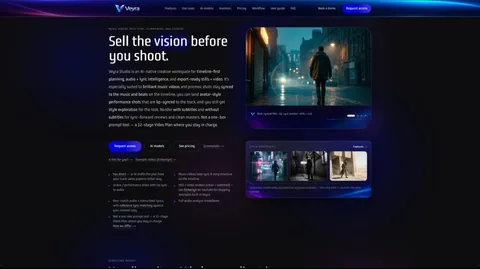
Veyra Studio is an AI-native creative workspace designed for cinematic planning — a place to take a music video, promo or visual project from idea to coherent sequence before the shoot. The premise is simple: sell the vision first, and the production follows.
The challenge.
Advanced creative technology is easy to build and hard to present. The challenge was making a sophisticated workflow — visual exploration, timeline planning, audio and lyrics, style references — feel approachable through a web application, without burying the creative outcome under the tooling.
How it progressed.
Work began with naming and product branding in April 2026. During May the focus moved into interface design and video-production functionality: an experience that puts what the user wants to make first, then introduces the planning and production features underneath it.
Interface as the product.
The finished site leads with the creative result. A dark purple-and-cyan identity, strong imagery and clear routes into the product work together, so atmosphere never comes at the cost of practical entry points into the tools.
Designing for AI-native workflows.
Most creative tools today have AI features bolted on; Veyra was designed as an AI-native platform from the start. That shows up in the workflow itself: prompts and generated frames are first-class objects you keep, compare and iterate from, rather than an appendage to a traditional timeline.
The interface treats generation as conversation — each iteration of an outcome is visible, annotated and recallable, so creative direction stays coherent instead of dissolving into a folder of near-identical exports.
Naming and identity as interface groundwork.
Before any screen existed, there was studio brand craft: naming, positioning, and an identity that could stretch from a product site into the application itself. That groundwork also set the vocabulary the interface uses — the words inside the product carry the same voice as the brand outside it.
It is a detail clients often skip, and it shows: when product surface and brand speak with one voice, the tool feels considered from the first click rather than styled at the end.
From brand to product surface.
A recurring risk for creative platforms is that the brand stops at the front door: the website is gorgeous, the tool inside is generic. Veyra's build treated the identity as the seed of the interface — the same voice, the same confidence, carried into the working screens — so the product is the brand rather than a place the brand visits.
That continuity shows up in small, deliberate ways: the language of the tool, the tone of its feedback, the way empty and waiting states are styled. Users read all of it, even when they never consciously notice.
Working with generative material.
Generative tools produce good work and bad work with equal confidence, which makes the human role different rather than smaller: curation. Veyra's workflow is built around that reality — comparing candidates, marking directions worth pushing, discarding without guilt — so the creative director stays creative director.
The interface makes review a first-class act rather than an afterthought of scrolling through folders. Where the next generation starts is always visible: one click from the frame that earned it.
The economics this changes.
The honest commercial story of AI-assisted creative production is not “more video”, it is iteration. When producing another version of a shot costs minutes rather than another production cycle, the barriers to exploring an idea properly fall away — and the work gets better because the good direction is found while it is still cheap to look for it.
A platform built for that loop is a different product category from a tool that merely generates footage. The value sits in the workflow around generation: briefs, candidates, feedback and delivery in one place, with the studio's taste applied throughout.
Where Veyra goes next.
The platform continues to grow along two axes: deeper support for the production workflow it was founded to serve, and the collaboration features that creative teams of more than one person start to need the moment they begin sharing the working space.
For now, the honest summary is the one the platform's own story tells: a design-led product in an emerging category, built by a studio that believes interface craft is the moat when the underlying generation technology is available to everyone.
What this demonstrates.
For studios and creative businesses, this is what bespoke product development looks like: brand, interface and workflow designed as one thing. If your product needs to make complex technology feel effortless, the Veyra approach is one we can repeat for you.