
Where AI actually helps.
Used well, AI compresses the unthinking parts of software development: scaffolding boilerplate, generating first-draft tests, automating repetitive transformations, surfacing likely bugs in unfamiliar code. Used badly, it produces confident code that nobody has reasoned about. The difference is an experienced engineer supervising the output.
The workflow.
This studio's practical workflow pairs modern coding assistants with deliberate review: AI drafts, the engineer verifies against intent. Cursor-style tooling speeds iteration inside the codebase; local LLMs handle context that shouldn't leave the machine. Debugging, code review and architecture decisions stay explicitly human.
Quality is the guardrail.
Velocity without verification is debt. The rule that keeps AI acceleration honest: every AI-assisted change faces the same scrutiny as a hand-written one — tested, reviewed, and judged by whether it will still be maintainable in a year. AI accelerates experienced developers; it doesn't substitute their judgement.
The workflow in full.
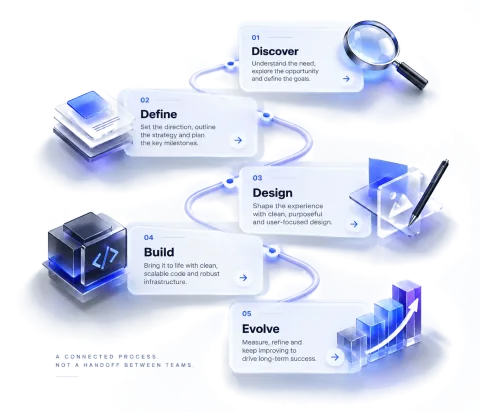
In practice, a feature arrives as a specification first — written to be handed over, whether the receiving hands are human or AI. Scaffolding, test backfill and mechanical refactors are delegated to agents; interface decisions, security-sensitive code and the final review stay firmly human.
The important shift is what gets written down. Tasks that used to live in one developer's head now get specified carefully enough that anyone — or anything — can execute them, which would be good engineering practice in any era.
Where we are deliberate.
AI is used to increase attention, not to spend it elsewhere. Review remains the discipline that makes delegation safe: agents produce diffs, humans own merges, and nothing ships because a machine sounded confident.
The longer-term observation from eighteen months of this workflow is intellectual honesty about which parts of the job changed: the mechanical middle got faster, and the specification-and-judgement ends got more important. We wrote a fuller toolkit review on exactly that theme.
Spec-first culture.
The deepest change AI brought to the build was accidental: because agents need precise instructions, the studio was forced into a spec-first culture, where every delegated task arrives with context, constraints, acceptance criteria and stopping conditions. Delegating to a human works exactly the same way — which is why the practice would have been worth adopting even without the AI motive.
The payoff compounds beyond AI: estimates improve, handovers between people stop dropping context, and the specification artefact outlives the feature as accumulated documentation of decisions.
Choosing tasks for agents.
Task selection is a risk calculation rather than a capability question. The criteria: how testable is the outcome, how expensive is a wrong turn, how contained is the blast radius — and the honest answers sort work into tiers that determine which tools are permitted to touch it.
Free agents take the low-risk mechanical tiers, audited paid setups cover the middle, and the specification-and-judgement work — the part that decides whether the software is worth building — has never been delegated by anyone at this studio. The toolkit review has the full scoreboard.
What quality means now.
Quality gatekeeping survived the AI transition intact because it was never the typing that made work good. The pipeline still fails loudly on type errors, budget breaches and broken checks — and an agent that finishes a task without passing those gates has not finished the task, whatever it believes.
If anything, the bar got higher: with generation cheap, the relative value of review rises, so each merged diff is read more carefully than the sprawling change it replaced. Speed up the middle; keep the ends human. That is the method.
If you are starting from scratch today.
The advice for a team beginning with agents: start with the safest tier — test backfill and mechanical refactors — before touching anything customer-facing, and invest in the build gates first, because delegation without verification is just outsourced hoping.
Keep a written review checklist, expect the first month to feel slower than doing it yourself, and measure the second month rather than the first. The teams who benefit treat adoption as an engineering discipline; the teams who struggle treat it as a shortcut.
What this demonstrates.
Clients feel this as delivery speed without quality drift: real, verifiable progress on bespoke builds, from someone who understands both the tools and the craft.